Organization
What Belongs in the Home Binder, and What Belongs in the Garden Journal
Mea Cara · November 5, 2026 · 5 min read
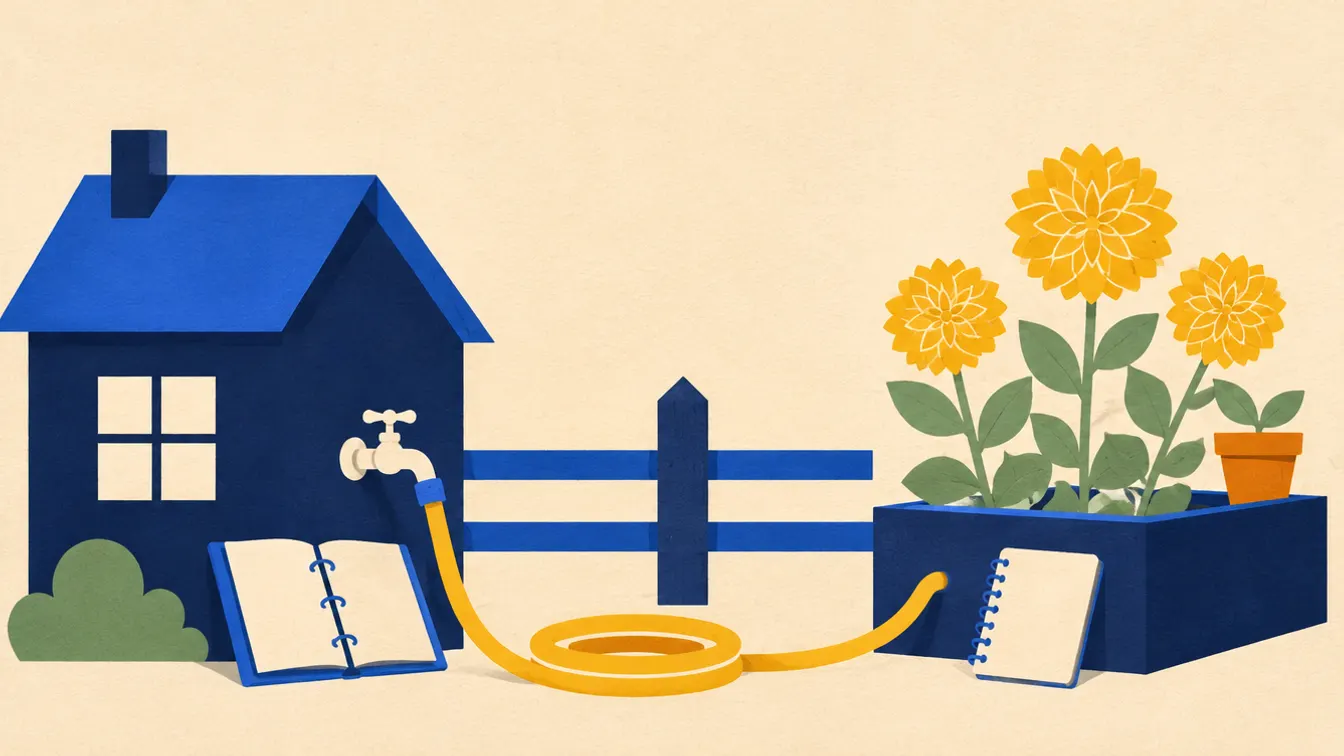
Somewhere between the back door and the far fence, the house stops and the garden starts. It is not a clean line. The outdoor faucet is the house. The hose on it is, more or less, the garden. The irrigation line under the lawn is the house's plumbing; the lawn it waters is the garden's. Most of us keep one set of notes for all of it, or none, and the result is a hose left on the faucet in November and a dahlia nobody can name in May.
Two kinds of record want two different homes. Here is a simple way to sort them, and what to write down on each side before winter.
The test: does it come with the house?
Ask two questions about anything outdoors. Would it stay behind if you sold the house? And would it be expensive to let it fail? If the answer to both is yes, it belongs in the home binder, next to the furnace and the water heater. If it is alive, or you chose it, or it would come with you in a pot, it belongs in a garden journal.
The house side
These are the yard's fixtures. They break the way plumbing breaks, and the repair is a contractor, not a trowel.
- Outdoor faucets and their shutoffs. Where the interior valve is, and whether the hoses came off before the first hard freeze. A faucet with a hose still attached is the most common frozen pipe there is; how to prevent frozen pipes explains why.
- The irrigation system. Who installed it, the controller's model, the zone map, and the date it was blown out each fall. A line left full of water is a spring repair bill.
- Gutters and downspouts. When they were last cleaned, and where each downspout sends the water. Into a bed is fine. Against the foundation is not.
- The structures. Fence, deck, retaining wall, shed, patio: when they were built or sealed, and by whom.
- Pumps and power. The sump pump, the pond or pool pump, outdoor outlets and lighting, the well if you have one.
- The trees near the house. Not their care, but their risk: the limb over the roof, the one leaning on the power line, the last time an arborist looked.
All of this is on the winterizing checklist, and most of it repeats every year on the seasonal maintenance schedule.
The garden side
These are the living things and the choices you made about them. They do not break; they grow, die, move, and get forgotten.
- What is planted where, by variety, and when it went in.
- What came out before the frost: the dahlia tubers in the basement, the geraniums on the windowsill, which box they are in.
- What you did to the beds: compost spread, leaves shredded over the garlic, the soil test result.
- Dates that move every year: the first and last frost, when the garlic went in, when the seeds should start indoors.
- What worked. Which tomato earned its space, which bed was in shade by August.
Those are a garden journal's whole job, and it is a job HavenBinder does not try to do. GardenBinder does. It is a garden journal from the same people who make HavenBinder: plants, beds, photos, and seasonal reminders, phone-first, and free to start. Its fall garden checklist is the garden half of the list above, and it has guides on storing dahlia tubers, getting hydrangeas through winter, and what to do with the leaves once they come down.
The things that are both
A few items sit on the line, and the trick is to split them rather than pick a side.
- The big tree. Its pruning and its health are garden. The limb over the roof and the arborist's bill are house.
- The irrigation. The pipes, valves, and controller are house. Which zone waters which bed, and for how long, is garden.
- The leaves. Shredding them over the beds is garden. Getting them out of the gutters before they freeze is house.
- The bed against the wall. The plants are garden. The soil piled against the siding, and the water it holds there, is a house problem waiting to happen.
Why not one notebook for everything
Because the two sets of notes have different lives. The house's records go to the next owner; a buyer wants to know the irrigation was blown out every fall and when the deck was sealed. Your garden notes are mostly yours, though a plant list is a kind gift to leave behind. The house's list repeats once a year and is mostly about not letting water freeze. The garden's changes every week from March to November. Keeping them apart means the yearly list stays short enough to actually finish, and the garden one stays a pleasure rather than a chore.
This week, if the hoses are still on: disconnect them, drain the outdoor faucets, and write down the date. Then go and lift the dahlias. The first job is the house's. The second is the garden's. Neither takes more than an hour.
What to write down, on each side
In the home binder: the date the hoses came off, who blew out the irrigation and what it cost, where the interior shutoff valves are, and when the gutters were cleared. HavenBinder keeps those on a seasonal checklist that only lists the equipment your house has, and it is free to start.
In the garden journal: which beds got leaf mulch and how deep, which dahlia clumps went into which box, and the day the frost came. GardenBinder keeps those, from the same makers, with a photo of the bed and the date as the whole entry.
#organization #garden #records #seasonal #winterize